

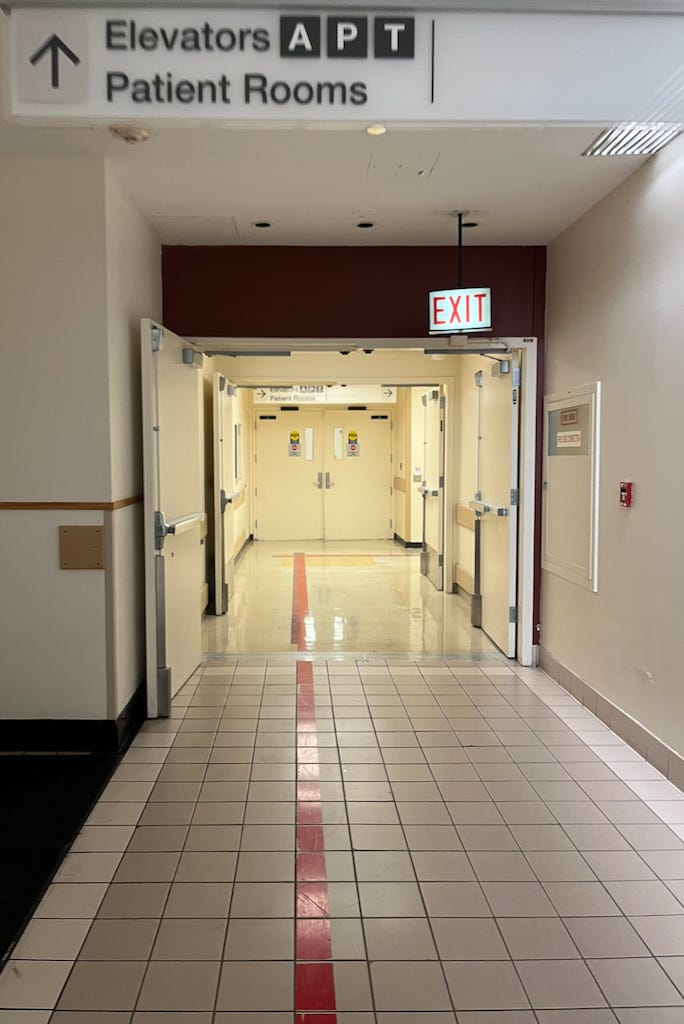
To sit for half an hour in the way station in the bowels of a big-city medical center, a room filled with folks awaiting scans and MRIs and the radioactive dye that will course through their veins, and light up the lights soon as a cancer shows up on the screen, is to be plunked in the deep end of the Things-Get-Real-Here Pool.
To spend six hours wandering the halls of said medical campus, idling in waiting rooms, catching a breath of fresh air in the courtyard outside (where the whir of the Medivac helicopter rising off the rooftop is haunting testament to the proximity of human frailty), submitting to needles, to scans, to tight tête-à-têtes with a phalanx of techs and, finally, the doctor: it’s Things-Get-Real-Here compounded.
To find your way to the subterranean way station, the room where you wait for your turn in the all-seeing machines, to be sure you don’t get lost, they tell you to follow the red line. Literally: the line laid out in red-tile squares inscribed into the shiny linoleum floors, turning this way and that till you get to the sign with the arrow pointing emphatically down.
You’ve arrived, you realize, when you step off the elevator and find yourself adrift in a vast and windowless room where people sit slumped and listing and bent. Spines seem to crumple here where no one sits straight. Everyone waits; each someone’s waiting filled with frame-after-frame of the story of how they got here, and how very much they want to get out, to get to the other side of whatever is holding them here.
Once I found my seat there, after I’d recited the usual name, birthdate, reason for being, I opened my phone and saw right off the bat, the poem for the day: Elizabeth Alexander’s “Praise Song for the Day.” The gods here have senses of humor. Or irony anyway. Or maybe their purpose is as pointed as could possibly be. And directly on target. Lest we forget: Praise this day. Yes, this day, this room where I sit amid a sea of murmurings, prayers in a thousand languages. Where folks lean in to each other, ear to cheek, whispering, hoping, beseeching. Hands reach for hands, squeezing so tight knuckles turn pale. A groan rises up from no one knows where, abruptly punctuating the somber stillness that hangs like still air over row after row of anonymous worry and fear.
We all melt into one here, my messed-up lung lands me in the same spot as your tangled kidney, your blurry vision. Here, we all are aware of the sharp edge of our mortality. We are broken bodies here. But, too, we are dreams that won’t die. Stories with pages to go.
Prayers must ascend here, collectively, in a breath-driven vortex, from down in the hollows of the Bernard A. Mitchell Hospital straight to the heaven above. If there’s an address to heaven this day, it’s 5815 South Maryland Avenue, 60637.
The words on the lab orders don’t lie. They spell out just why you’re there. And it’s never a common cold.
What I love most here is how it doesn’t take long for walls to come down, for silence to be broken, as all of us strangers chip away at our anonymities. It comes, first, in unspoken increments: warm blankets passed among us, knowing looks exchanged, the occasional sigh. Words, then, fill in the cracks. And by the time your turn in the tell-all machine finally comes, a chorus of church-like affirmations, good lucks, and God bless you’s arise from the ones with whom you’ve waited it out: the woman in purple from head to toe (and I mean from hat, to earrings, to socks and to shoes with the sparkly sequins), and the one with her head wrapped in a turban.
Most of my life, I’ve been drawn to these places where human frailty is most exposed.
The liminal spaces where Things Get Real, where even for only an instant the veil gets lifted, where all of us are stripped to our barest humanities.
It’s what I loved most about being a nurse: the rare chance to slip inside that most intimate, fiercely-guarded, utterly sacred space.
These are the places where we can see just how very kindred we are. We all, each of us, are made from the same flesh and bones. We shiver with cold. And with worry. We bury our heads in our hands. And we reach across the arms of our chairs, to press a hand into our own. Sometimes, even a so-called stranger’s.
These are the places where we see up close and in astonishing detail the capacity of human beings to reach down deep to where the most unanswerable questions lie, to see how little it takes for each of us to strip away the layers and masks that so often disguise us, keep us safe distance apart. Those illusions that make it seem as if we’re not simply ragbags of rare few essentials: We want to be loved, all of us; we want to be seen and heard. We want not to be alone in our fear or our pain. We yearn to feel warmth against our cold flesh.
My day at the U of C hospitals left me ragged, and worn. Left me dizzy. Poked with a few extra holes by the time I headed back to the parking garage, where license plates from far-away states tell you how far folks will drive for a dollop of hope, and the best that modernday medicine might offer.
I couldn’t stop thinking of all the anguish I’d witnessed. And all the infinite goodness. The unbreakable instinct to shatter the distance between us.
Exhibit A: the radiology tech who saw three of us in a row all but chattering our teeth we were so cold, so she stopped in her tracks, turned on her heels, ducked into some closed-off chamber, and emerged with a stack of incubator-warmed blankets to cover our goosebumps. Or, B: the receptionist at the check-in window who, over and over, repeated her mantra to a lady so nervous she could not sit down: “You’re gonna be ok, I promise. They’re gonna treat you good. You gonna be ok!”—an unabashed act of humanity breaking through the monotony of name, birthdate, and time of appointment. Or, C: standing in a long slow line to check in at the hematology/oncology clinic, one woman leaned into another and whispered, “You have very pretty hair.” To which the other replied: “Oh, thank you, I don’t feel too pretty today.” And a third someone, the man standing two people ahead, without even turning his head, offered up this: “May you feel pretty every day.” Amen.
In places like these, we remember who we all are, how close to broken we sometimes can be, and how time after time we make each other whole. Through nothing so hard, nor so foreign, as love, pure, simple, and plain.
Where did you find the deepest pool of humanity this week?
Yes, first your name and then your birthdate. Repeat after me. The endless waiting rooms of the medical maze.
Chicago had Upton Sinclair, who bore witness to the meat packing district and it’s horrors. In a way you’re giving voice to the nameless now, honoring them in their existential moment.
Really you’ve been doing that all along with your writing. Opening doors to let the light in.
I knew that room well, waiting with my husband while he was going through treatment. One day, he leaned over to me and whispered, "You heat the city of Chicago with the anxiety generated in this room." Also, I'll always remember the brother of patient who we got to know who made wonderful soup and several times, brought extra for John. Just a wonderful heart.