

It must have fallen in a crack, I finally figured. In one of those tight squeezes between the tomes lined up straight-backed-soldier-to-soldier on my shelves. I pulled out drawers, scanned shelf after shelf, roamed room to room, and resigned myself to knowing that some day it would turn up, tucked between the pages of a book that doesn’t have his name on the title page.
It’s a letter from the summer of 2014. July, specifically. And I knew it would have been postmarked Port Royal, the real-life Kentucky town from which the fictitious Port William was drawn. It was a letter of regret, to be sure, but one I remembered as gracious and soft-hearted a regret as one could possibly read—or write. This one was written by the hand of a gentle, gentle man, a man who carved out the time to lift his pen from his writing desk, the one from which he looked through the window upon the acres beyond and below, the tobacco fields no longer growing the timeless crop, down the hillside to the river running by.
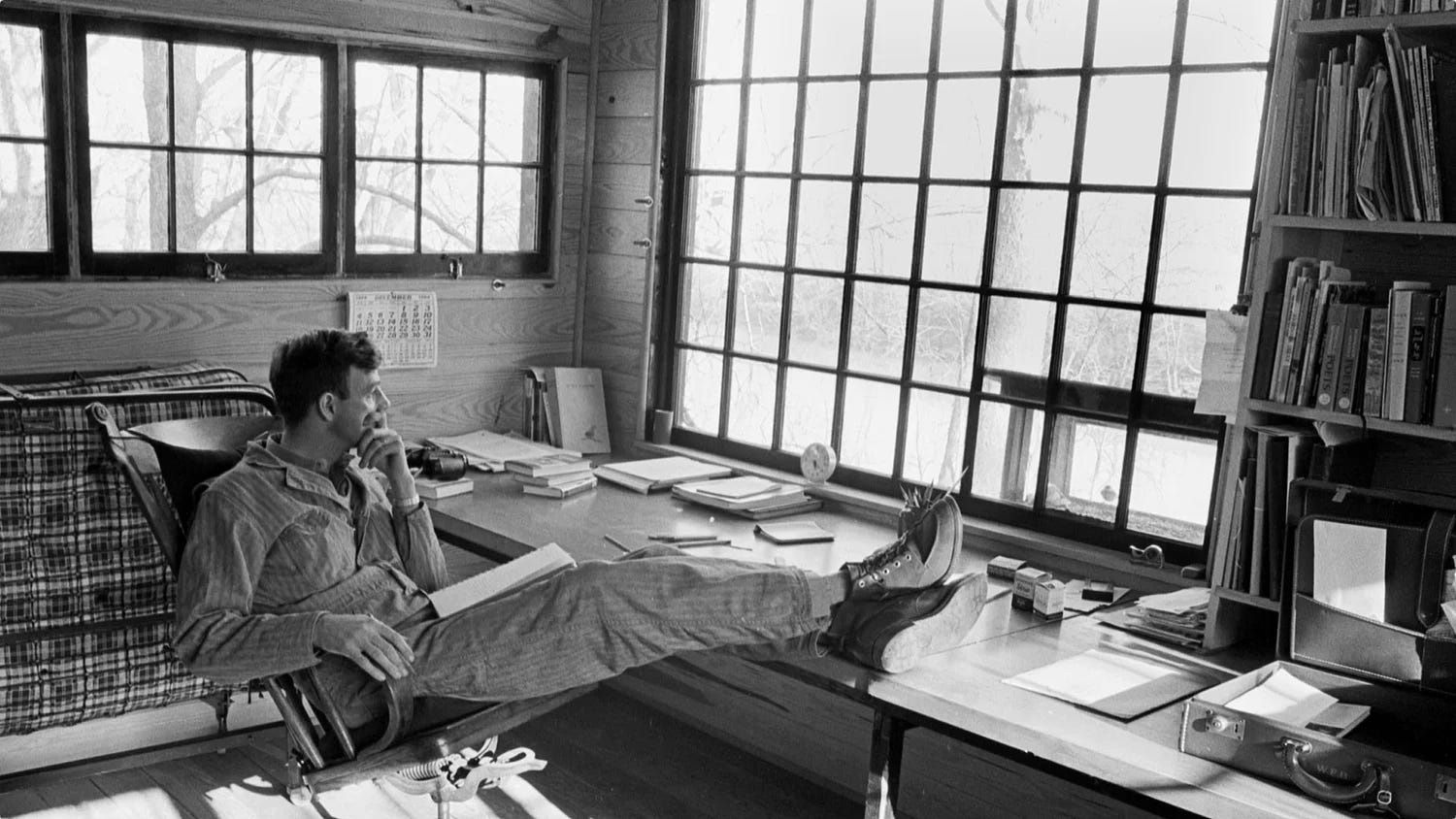
The window, famously, was forty-paned. Wendell Berry, the gentle man who wrote the letter for which I searched, wrote indelibly of that window, considered it the focus of his seeing. And, oh, his seeing was superb. Otherworldly. Supernatural, some might say. I say, saintly.
“The window has forty / panes, forty clarities / variously wrinkled, streaked / with dried rain, smudged, / dusted,” he wrote back in 1968, in an early sequence plainly titled “Window Poems.” He described his glass-paned lens: “The frame / is a black grid / beyond which the world / flings up the wild / graph of its growth, / tree branch, river, slope of land, the river passing downward . . .”
The letter for which I searched for the better part of a day is the letter Mr. Berry once wrote to me. At last, and with deep joy, I found it, the one-page sheaf neatly dated “7/10/14,” a mere two days after the one I’d mailed to him. The gentle farmer wrote: “Dear Ms. Mahany, I’m sorry to have to say that I had to give up blurb-writing a good while ago, just for want of time to do the required reading. This is regrettable but necessary. Sincerely, Wendell Berry.”
I had asked Mr. Berry if perchance he might have the time and inclination to review my first book, Slowing Time, for possible endorsement. And, because I knew he trod not on cyber-wires and e-mail but rather relied on the mostly reliable U.S. Postal Service, I’d sent along a self-addressed, stamped envelope and awaited his reply. (For the record: There is no more onerous task in the making of a book than to have to beseech an author you hold in highest regard for a so-called blurb, a peculiarity of publishing that sounds as guttural and dyspeptic as it feels. To have had to ask it of a fellow Kentuckian [I was born there] made it not one bit less onerous.)
For reasons I can’t remember, other than to run my hand, my eyes once again across the faintest remnant of a poet, a prophet, now gone from this sweet earth, I set off the other morning in search of that letter.
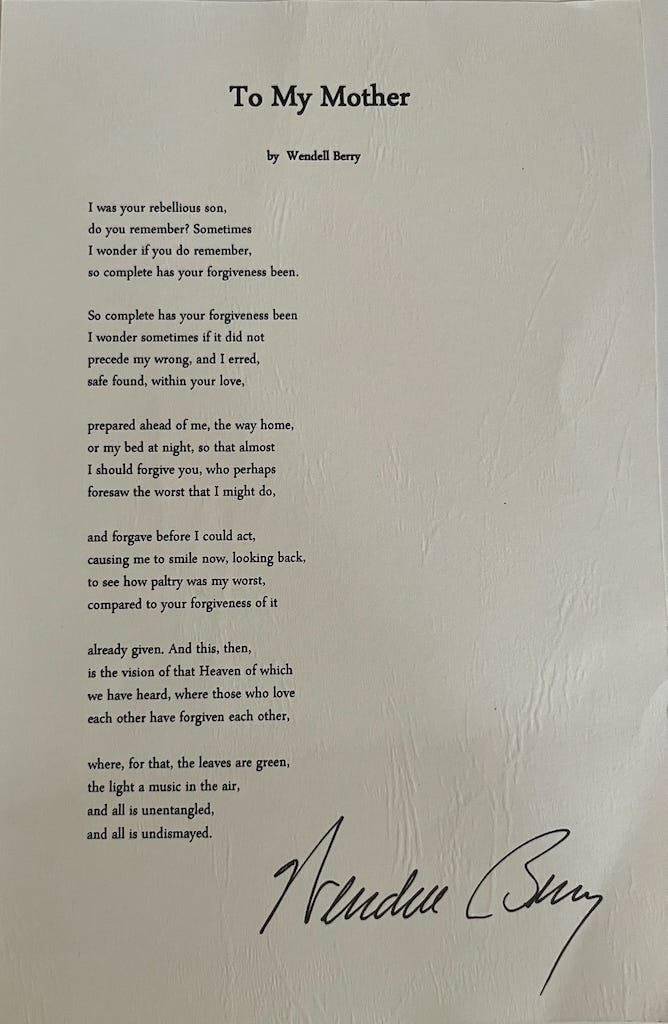
Even before I finally found it (wedged not between the pages of a book, but tidily filed in a bin marked “Slowing Time”), my search was hardly fruitless. Along my way I found another note, an inscription he once wrote on the frontispiece of Sabbaths 2013, a chapbook printed on sturdy stock—with wood engravings. And still more: yet another slip of paper, again one he signed with his black-inked pen, a poem that took my breath away. A poem I hadn’t remembered but that once I read made me remember once again why poets are those we turn to to put words to the ineffable. “To My Mother,” it is titled. And it made me weep.
Poets—and Mr. Berry among the finest—wield the gift of sifting through life’s many, many tangled threads, and pulling up the finest silken ones. Holding them to the light, and capturing in pure precision—uncanny precision, the sort that catches your breathing right there and then because their vision is so beyond the ordinary.
Poets see into the liminal. Poets dwell in the liminal, the ephemeral. All those parts of life that otherwise elude us, the ones we might vaguely, vaguely sense but otherwise barely regard (akin perhaps to knowing the distant planet Pluto floats out there in the deep darkness but hardly concerning ourselves with whether it spins or wobbles until some headline someday shouted news we needed to know and suddenly it was the only object of our attention, and we wondered how we’d gone so long without noticing . . .).
Mr. Berry—a fifth-generation (if not more) farmer who tilled his field with a pair of Belgian draft horses and a plow, a farmer who reached into the seed bin, filled his palm, and scattered tiny grains across the loam, or poked a thumb hole and laid down a single seed at a time, awaited its arising, believed in its arising—more than earned his mark as “the prophetic American voice of our day.”
A poet-conservationist I’d rank with Thoreau and Frost, he possessed a soul so rooted in the earth, so fluent in the whispers of the land, the wind through cottonwoods, the pit-a-pat of rain on windowpanes, front porches, and the greenery along the riverbank, that every word he wrote (mostly in pencil, and mostly by candlelight or sunlight, without electric lights) ran taut within the grain of the agrarian world he put to the page.
Mr. Berry, like all great poets, taught us to see, and spent the last half-century-plus (62 years, to be precise) unspooling those lessons, poem after poem. It’s the seeing, as much as the plucking of words, that makes the poet a prophet, that makes the poet indispensable, imperative. Not regrettable but necessary, to upturn Mr. Berry’s own phrasing. He teaches us, in poem after poem, and in his plainspoken pastoral prose, to look into the sacred, to grasp and see the moral crux. To seize—and see—what we might just miss.
It’s not that he wanted us to see more but rather that he wanted us to see more deeply. To understand that “the small, the subtle, the quietly observed thing often reveals the most profound truth,” as the writer Brett McCracken once put it. Indeed, there is the endosperm of William Blake’s “Auguries of Innocence,” embedded in the Kentucky farmer’s poetic DNA, certainly in “Auguries’” first stanza:
To see a world in a grain of sand
And a heaven in a wild flower,
Hold infinity in the palm of your hand
And eternity in an hour.
It’s a poem that ends with this:
God appears and God is light
To those poor souls who dwell in night,
But does a human form display
To those who dwell in realms of day.
Mr. Berry, who died on August 31 at 92, left behind his wife of 69 years, two children, five grandchildren, four great-grandchildren, a 125-acre farm, and more than fifty volumes of poetry, fiction, and argument that, according to the New York Times, “championed small family farms, the environment, local foods and interdependent communities, and railed against chemicals, most technologies, agribusiness and distant government.”
At heart, the driving force behind his life’s work, be it from his old tobacco barn on the ridge overlooking the Kentucky River, his writing desk at the forty-paned window, or the many podiums from which his baritone so often boomed, was nothing short of a campaign to save this holy earth and the human spirit that, at its best, animates and bends the moral arc toward justice.
“His writing has sometimes been called radical, but he thinks of himself as a conservative, conserving what is most human in our landscapes and ourselves,” wrote journalist and artist Paul Trachtman in a 2005 Smithsonian magazine profile. “You know,” said Berry in that profile, “if you subtracted the Gospels and the Constitution and the Declaration of Independence from my work, there wouldn’t be very much left.”
But, oh, there’d be a motherlode of soul. And beauty in abundance. The ineffable netted for all time.
A few Wendell Berry poems:
Window Poems Part III
(from New Collected Poems by Counterpoint Press, 2012)
The window has forty
panes, forty clarities
variously wrinkled, streaked
with dried rain, smudged,
dusted. The frame
is a black grid
beyond which the world
flings up the wild
graph of its growth,
tree branch, river,
slope of land,
the river passing
downward, the clouds blowing,
usually, from the west,
the opposite way.
The window is a form
of consciousness, pattern
of formed sense
through which to look
into the wild
that is a pattern too,
but dark and flowing,
bearing along the little
shapes of the mind
as the river bears
a sash of some blinded house.
This windy day
on one of the panes
a blown seed, caught
in cobweb, beats and beats.
Window Poems #7
(published in The Hudson Review, Summer issue, 1968)
Outside the window
is a roofed wooden tray
he fills with seeds for the birds.
They make a sort of dance
as they descend and light
and fly off at a slant
across the strictly divided
black sash. At first
they came fearfully, worried
by the man’s movements
inside the room. They watched
his eyes, and flew
when he looked. Now they expect
no harm from him
and forget he’s there.
They come into his vision,
unafraid. He keeps
a certain distance and quietness
in tribute to them.
That they ignore him
he takes in tribute to himself.
But they stay cautious
of each other, half afraid, unwilling
to be too close. They snatch
what they can carry and fly
into the trees. They flirt out
with tail or beak and waste
more sometimes than they eat.
And the man, knowing
the price of seed, wishes
they would take more care.
But they understand only
what is free, and he
can give only as they
will take. Thus they have
enlightened him. He buys
the seed, to make it free.
And here’s the one that made me weep. Please, read closely.
Poetry wasn’t the only gift Mr. Berry bequeathed. Not too long ago, there was The Wendell Berry Farming Program, a tuition-free residential undergraduate program, last rooted at Sterling College in Vermont, and perhaps the only college program with courses titled “Draft Animal Power Systems” and “Literature of the Rural Experience.”
According to a 2020 piece in Hearth & Field, an online and print magazine that bills itself as “the most trusted name in high-Christology, low-technology, practical, philosophical, money-saving, quasi-luddite, quarterly, literary journals,” the farming program was thusly described:
“Students read Virgil, Aldo Leopold, Chaucer, and contemporary pieces by Crystal Wilkinson, and then put on their muck boots and take the reins of a draft horse to cut a row in a field. They learn forestry from experts who share an appreciation for their craft and love for their place. They participate in the beef cooperative, ‘Our Home Place Meat’, and learn first-hand the challenges of raising, producing, marketing, and selling meat. They meet the kin of black tenet farmers who helped build Henry County and hear the tales, both good and bad, that have formed the ethos of the land and community. They walk the hollers and read stories in the very places they were written. They are taught to look, and to see. To enter into the richness and depth of the people, the place, the land around them.
“. . . The focus is not just on the looking: the passive, the utilitarian, the transactional —it is on seeing: knowing, relating, walking with, and entering into.”
Nowadays, it’s known as the Berry Center Farm & Forest Institute, and it’s moved to the Berry Center in New Carlisle, Kentucky. No longer an undergraduate degree program, these days it offers “affordable workshops, short-courses, and field days,” and is one of the center’s cornucopia of initiatives, from selling Our Home Place Meat (pasture-raised Kentucky beef) to peddling shelves of “the best of Kentucky letters” (of course, Mr. Berry’s among them).
My questions of the week are all Berry-esque: Do you have a Berry poem, or line, you know by heart? Is there another poet who stirs your soul in the ways that Berry might? Why do you turn to poetry when all else fails?
*the image way up top is from the back cover of Window Poems, and that’s Mr. Berry circa 1968, his boots atop his writing desk, looking out the famed forty-paned window.