

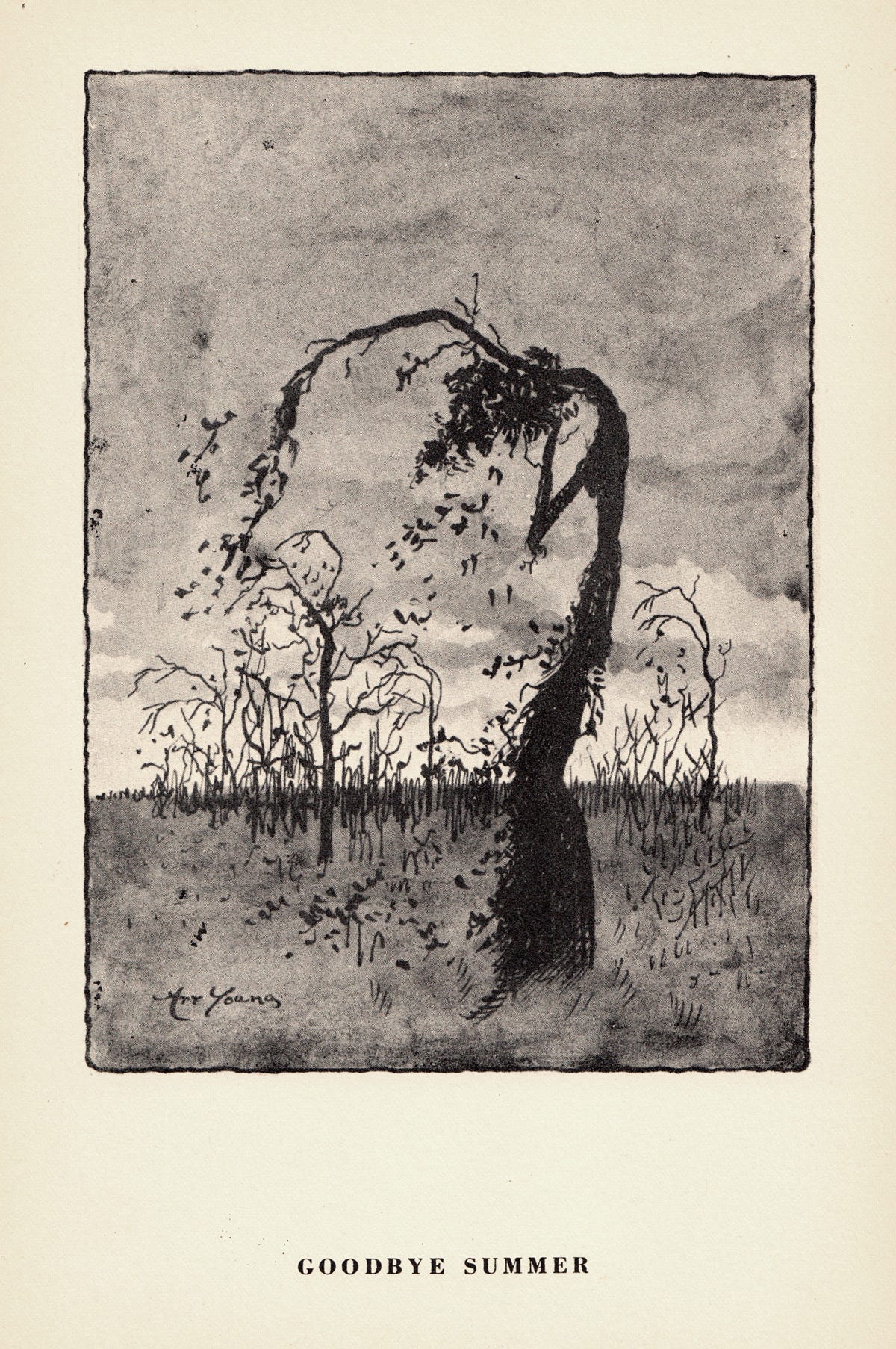
All around, the chorus rises: the moaning, the protest, the insistent “Not yet!” It’s a song filled with sorrowful notes, of something being taken away, of resistance to moving along.
I, though, hear another song, one just as richly punctuated with notes of yearning, of loss, of golden-tinged beauties, of drinking it in. It’s a song that, for all these years now, has proven to be my elixir. It never fails to draw my soul out from the trenches, sets it soaring to once-a-year heights.
It’s the end-of-summer song, and from whichever angle you hear it, it’s bound to stir something.
For me, the something is full-stop arresting.
Soon as the cicadas and crickets warm up their evensong strings (did you know—I did not—that each August bug has its own sonorous time slot: dog-day cicada, twilight for crickets, and nighttime belongs to the katydid), soon as the last gasp of summertime’s heat is exhaled from the day, from the earth, and the bugs get to banging it out, I hear the song of autumn’s coming. (E.B. White once wrote that “the crickets spread rumor of sadness and change.” Oh, to hear such an entomological murmur and think “rumor.” The very reason we turn to the bookshelves to save us.)
Autumn, the season that breathes evanescence. Everywhere is nodding toward dying, if you look deeply enough. But it’s a death infused with gold tones: amber, molasses, and honey—a gold-wash that whispers, Be not afraid. It’s the timeless equation. Autumn reminds us: Time passes. Seasons draw to a close. Stirring will come again. But not till we’ve entered the quiet, the coil of winter. Not till well after this season’s a wrap, its time in the past.
To wither, to fade, to shed petal or leaf or plain old vigor is not to be feared, nor fought against. It is to follow the ancient prescription: to enter the endless cycle, life to death to stirring again. In one form or another.
The infinite genius of the wheeling of the year, of time, of sunlight and shadow. Holy God, you have so much to teach us—again and again and again. We humans, we’re a dull species. We need our wisdoms in back-to-back doses. We never catch truth on first try. So we are enrolled in remedial school: the one where the lessons are drummed in, played on a loop, year after year after year.
I’ve never quite untangled just what it is that so stirs me in these liminal days. Maybe it’s simply being drawn to thin places, thin times, those hours when heaven and earth all but touch lips. (The rabbis teach us, I’ve read, to pray in those hours “when day and night kiss.”)
Maybe it’s little more than my addiction to crispy cold apples and the nubbiest of sweaters. Maybe it’s because I used to love sliding into a new school desk, figuring out the ways of the new year’s teacher. And I definitely consider it pre-ordained that I’ve so effortlessly slipped my soul into the sleeves of Judaism where each autumn brings the holiest of holy times: the Days of Awe. I pry open my soul and I pray. Oh, do I pray.
It’s all so fitting, as Earth turns away from the white-hot heat of the summertime sun—when I feel baked and over-exposed—that I feel the fullness inside, in keeping with those end-of-season fruits teetering toward their most zaftig proportions. It’s as if I, too, am ripening.
And I know I am not alone. There is, it seems, a whole herd of autumn keepers. The poetry shelves are stuffed with them. I’ve plucked a few juicy morsels from the end-of-summer boughs. But, first, I bring you the poetry of earth, a little recording of this glorious song I made as I stood in my garden, drinking it in, under the almost-stars the other summery night. . . .
And now, a dab of poetry of the wordly variety.
My polestar, Annie Dillard, first:
The North “sweetens the persimmons and numbs the last of the crickets and hornets; it fans the flames of the forest maples, bows the meadow’s seeded grasses, and pokes its chilling fingers under the leaf litter, thrusting the springtails and earthworms, the sowbugs and beetle grubs deeper into the earth.”
Henry Beston, naturalist, writer, farmer of early 20th-century New England:
How wise were the ancients who never lost sight of the religious significance of the earth! . . . They knew, as all honest people know in their bones, that in any true sense there is no such thing as ownership of the earth and that the shadow of any man is but for a time cast upon the grass of any field. What remains is the earth, the mother of life as the ancients personified the mystery, the ancient mother in her robes of green or harvest gold and the sickle in her hand.
And this from David Whyte (emphasis mine):
The Journey
Above the mountains
the geese turn into
the light again
Painting their
black silhouettes
on an open sky.
Sometimes everything
has to be
inscribed across
the heavens
so you can find
the one line
already written
inside you.
Sometimes it takes
a great sky
to find that
first, bright
and indescribable
wedge of freedom
in your own heart.
Sometimes with
the bones of the black
sticks left when the fire
has gone out
someone has written
something new
in the ashes of your life.
You are not leaving.
Even as the light fades quickly now,
you are arriving.
What song do you hear in end-of-summer’s chorus?
Reaching for a word that captures the essence of end-of-summer, I went searching, and came up short in English (note to self: concoct such a word), but not so in other world tongues. Herewith end-of-summer words, from the Danes and the archipelago of Japan:
Sensommer: A Danish compound word (”sen” for late, “sommer” for summer) that treats late August and early September as its own distinct, transitional season.
Natsu no hate: A Japanese phrase (夏の果て) meaning “the end of summer,” used to mark the subtle temperature shifts and fading days as autumn approaches.
Barbara, I love everything you write! And, this new word resonates. "Sensommer". I am currently waiting for the Italian Prune Plums to arrive to make a delicious plum tart- a favorite that only happens in Sensommer.
Love the Day and night kissing. Wonder of those who do not experience seasons. Blessed to have been drawn to you on the edge of a baseball diamond. What if I missed your connectedness, the lessons and the witnessing. Today they were flying the other direction in the sharp goldpink of the rising sun and I can think of new words to describe the feeling I had. Thank you, again.