

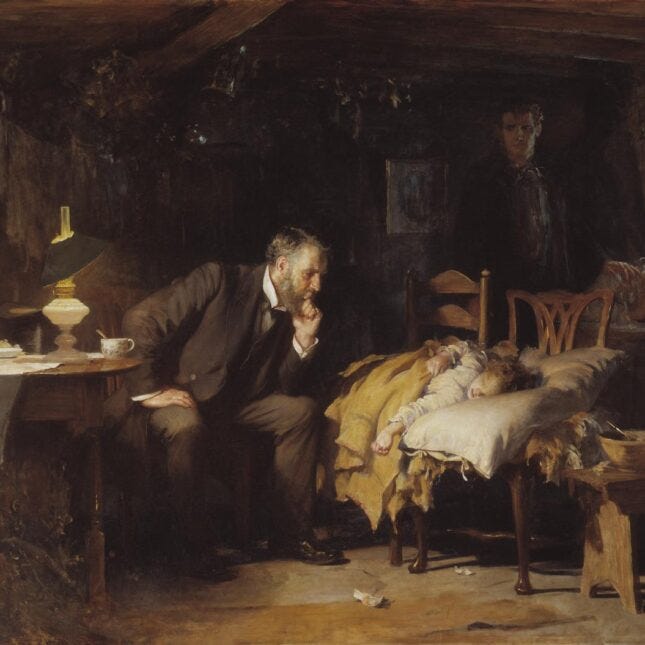
As long as there’s been a make-believe (a word I far prefer over “virtual”), scratched-up slab of maple table here at “the chair”—and that’s nearly twenty whole years now, minus five weeks and counting down swiftly toward 12.12.26—the modus operandi has been thus: I, the scribe who gets things started, scan the emotional landscape of the immediate past, and whatever is that thing that vibrates or gyrates the most, the thing that screams for high-voltage attention and promises a modicum of depth worth plumbing, that’s the thing we slide onto the table for some degree of consideration. This week, it happens to be the healers, those rare, rare souls who don’t merely plunk the thermometer under our tongue and read the itty-bitty digits, but those whose balms are downright alchemical, those whose ways restore not just the parts obviously broken, but all the ancillary tissues and invisibilities besides; quite often, the soul. Let us here praise the holy, holy healers…
If you opened my mychart (aka my portable medical records, the ones that follow wherever I go), you would see a roster of surgeons, physicians, nurse practitioners, speech pathologists, and physical therapists that might conservatively be described as “a lot.” My calendar these days looks something like a tic-tac-toe board with many a calendar square x’d out for appointments. If it’s not one thing falling apart, it’s another.
I hereby submit: It’s fair to say I know a thing or two about healers.
I know a good from a bad half a mile away. I know, too, how rare are the rare ones. And how finding yourself in their radiant penumbra for however many quarter-hour chunks you’re been slotted into their books, might leave you wondering how in the world you could be so thoroughly, emphatically, magnificently bathed in whatever mysterious vapors these restorers of body and soul exude.
I happen to have landed myself in the immediate care of two—the rare and the rarer—for whom I could, and might, write a whole book.
One is my oncologist. Yes, you read that right—a doctor who trades in the realm of godawful cancer, specifically cancer of the bellows, aka the lungs. A world-class research physician with the bedside manner of a guardian angel, a woman so extraordinarily tuned-in to her patients she presses her knees into yours when she is telling you the hard-to-hear things about the thing in your lungs, or rock-solidly telling you not to worry about that one other thing. (That she hails from Milano, Italia where she was chief of medical thoracic oncology at one of Europe’s most renowned cancer centers, and that her words pour forth with the exotic and charmed inflections of her native Italian oozing through every syllable, only adds to her hypnotic powers.)
Moving down a few body parts, Rarity Number Two is the rheumatologist who had at my knee just yesterday. My knee, which not long ago could trot along at five to six miles a day and still long for more, has since February grown gnarly and crooked and all but grounded me. I’ve been looked at up down and sideways, inside and out, and all the while that once-bendable joint seems only to be getting hobblier and worse. It didn’t take long for yesterday’s wizard of joints to give me a lowdown lifted straight from the pages of Fundamentals of Ortho, pointing to every darn part that was misaligned or inflamed, and otherwise out for the season. Before getting down to that bony business, though, she’d entered the room with a smile that, as my papa might have put it, could have melted the homeland of every last Emperor Penguin. And rather than conducting her lecture from half across the exam room, she pulled her stool next to my recalcitrant knee and all but massaged every last ache right out of it, all whilst pointing out its, um, shortfalls. Only then did she pull out the syringe and warn me of the coupla pokes soon to come. To which I squeezed shut my eyes while she pulled on that plunger and extracted a good quarter cup of goo from inside. And she fixed me up with numb-ers besides. And sent me off with a most curious concoction that goes by the name Picklebalm (if a gherkin to the knobby knee is what it takes, bring on the dills and the sweets and the spears and the slices….).
Despite the many words spilled above (400, I counted), none of it captures even a fraction of the glories of those glorious healers. And all of which is to say, healer might be just another name for miracle worker.
Which, it turns out, is not too far from the definitional truth.
Turning to that exemplar of English lexicography, the Oxford English Dictionary (a tome so voluminous it would crush my every toe, at 137.72 pounds, spanning 21,370 pages, with 291,500 entries) we find that healer is a word with not one but five meanings. The one I set out to find clocks in at number five. Herewith:
heal v. + -er suffix. n.
5. A person who or thing which restores something to a sound condition; a mender or repairer.
But before I got to five, though, I found myself hard-stopped at the top-line definition. Whereby we find:
1. A person who restores others to spiritual wholeness or saves them from sin; (sometimes) the Saviour; Jesus Christ. (usage that dates to circa 1225). (And though its Old English root word, healend, is now obsolete, it was once used as another name for God.) That’s some mighty deep etymology there!
It certainly begs some thought. Or maybe even a tad of meditation.
If the first-order meaning points to spiritual wholeness, offers the Saviour Our Lord in synonymous fashion (and might we agree, for our purposes, to cast aside that whole bit about sin?), and if we still need to scroll down a few pegs till we find the “mender or repairer who restores us” (or, perhaps, our shattered vase, yet another “something”) “to sound condition,” well then might we begin to be grasping something of the ineffable essence that ties the two definitions? The je-ne-sais something that captures the crux of the very rare healer’s almighty wares.
What I’m saying is this: In a world of makers and breakers, of bloviators and soft-spoken poets, of bomb-droppers and peacemakers, of hellions and heroes, there is among our species a rarefied subset of humans who wake up each morning hellbent on fixing and mending and making us whole. They are the healers worthy of praise. Gobsmackingly so.
While they’re schooled in the vast canyon of bodily function and frame, they seem never to lose sight of the soul. Theirs is an innate wisdom and an unflagging consciousness that we Homo sapiens are indeed shells of vessel and bone—the only container we know, from the day we are born to the day that we die. And yet, and yes, it is that friable, breakable, sometimes unbendable vessel that holds all our hopes and our dreams and our loves and our hurts. And the healers who heal us, or aim to anyway, tend to that too when they see us as whole, and attend to us as a poet to words, a painter to palette, astronomer to faraway star.
Blessed are the merciful. Blessed are those who see beyond sinew into the soul.
Nominate your own rare healer here, and tell a story of how it is that they healed so very much of the whole of you….
HoosierTales (a continuing reel of occasional Michiana slice-of-life love stories. . .)
I find myself back in that glorious corner of the world, hard by the Michigan border, deep in the heart of St. Joe County, where my nightly entertainment seems to be a swing through the local Save-Big-Money Menards, the 21st-century big-box throwback to the 19th-century hardware store, where when they say “Dedicated to Service” they mean dedicated. It’s my favorite place to trek when my heart needs a warming, and it never fails.
Just last night I was strolling the bright, shiny aisles for a whatchamahoojie to cover the knob on the kitchen light switch that tends to poke me each time I push it. Wandering through the outlet-cover aisle, I came upon a friendly fellow I remembered from other recent evening strolls. Told him what I was looking for, and how I couldn’t find the right beige, and he piped right up: “Let’s try paint, they’ll take care a ya.” Therein we met Tom. Tom, who works the 4 to 8 shift amid the cans and colors, let on right away that he has a real good eye, even if his eyesight is shot. He meant a real good eye for color. He grabbed for a spray can, and before I could read the label, he chirped: “Don’t think I’ll leave you with only one option. This here’s America, and it’s still the land of the free.” (How politics wound its way into spray paint, I don’t quite grasp, but we’ll leave that for another day.)
Anyway, before I knew it, Tom-with-a-real-good-eye was shimmying up the shelves of paint cans as if they were meant for mountain climbing, because what else you gonna do when the just-right, gloss-cottage-white is way up there on the tippy-top shelf. Once Tom came down, with just the right beige, he slipped on his film critic’s cap, and what followed was a 15-minute reel of all the movies in theaters I do need to see. “You deserve a break today,” he said with a wink (probably wondering if I’d ever heard the line before). And then he walked me half across the big ol’ box of a store to where the air-conditioner covers awaited. We parted ways then, but not before he repeated back to me our word of the day (quotidian; decided upon midway through the movie reviews), and I promised him I’d hightail it to a movie house for a viewing of Jimmy, “the untold true story of Jimmy Stewart.” And once again, as always, Menards is the place to go, if warming the heart is on your to-do list.
Ol’ Tom in paint got me feeling benevolent, so I am adding not one but two glorious poems for your perusal.
The Laughing Heart
by Charles Bukowksi
your life is your life
don’t let it be clubbed into dank submission.
be on the watch.
there are ways out.
there is a light somewhere.
it may not be much light but
it beats the darkness.
be on the watch.
the gods will offer you chances.
know them.
take them.
you can’t beat death but
you can beat death in life, sometimes.
and the more often you learn to do it,
the more light there will be.
your life is your life.
know it while you have it.
you are marvelous
the gods wait to delight
in you.
Charles Bukowski was an American poet and author known for his gritty and unflinching depictions of everyday life. His writing style, often categorized as “dirty realism,” is characterized by raw language, bleak humor, and an “unflinching portrayal of the underbelly of society.” His work explored themes of poverty, alcoholism, and the struggles of the working class. Both his poems and his stories rejected traditional poetic forms and instead unfurled in a direct, conversational style. Bukowski’s work emerged in the post-World War II era, a time of significant societal change and burgeoning counterculture movements, and his “approachable” style and focus on the mundane and the marginalized drew wide readership in the American literary landscape. His work is often found in a camp that includes Nelson Algren and, from distant shores, Franz Kafka, whose works similarly delved into existential angst and the absurdity of modern life. Bukowski died in 1994, but his unflinching honesty and stark portrayal of human nature, regardless of its flaws, offer a timeless commentary on the human condition.
Here’s one from a poet I’d not before known, a poet who went by the pen name Kaylin Haught:
“God Says Yes to Me”
I asked God if it was okay to be melodramatic
and she said yes
I asked her if it was okay to be short
and she said it sure is
I asked her if I could wear nail polish
or not wear nail polish
and she said honey
she calls me that sometimes
she said you can do just exactly
what you want to
Thanks God I said
And is it even okay if I don’t paragraph
my letters
Sweetcakes God said
who knows where she picked that up
what I’m telling you is
Yes Yes Yes
—Kaylin Haught
Born in Illinois and raised on the Oklahoma prairie, Haught was the daughter of a preacher and a factory worker.
Her most famous poem, which Billy Collins included in his Library of Congress poetry anthology, is the one you just read, “God Says Yes To Me.” You’ll never read a more mischievous, delightful, deceptively “mundane” evocation of God’s down-to-earth grace.
I happen to LOVE a great obit, and hers was a great one. Here’s some lusciousness from her 2018 obit, which begins as most obits do, without folderol:
Linda Kay Haught Sipe, also known by her pen name Kaylin Haught, died on Monday, August 27, 2018 in Grove Oklahoma at the age of 71.
But then things get more real:
She grew up in the green prairies of northeastern Oklahoma and loved to run wild in nature with her younger siblings, Carol and Steve, each being a year apart in age. Her youngest brother, Mark was born when she was 12 years old and passed in 2007. Years later Kaylin wrote about her memories of that time in Osage County, how she would swing off vines into muddy creeks and hunt for arrowheads along their beds. She was a preacher’s kid, but in her soul, Nature was Holy and Beauty was her religion.
The obit winds up with this:
Kaylin’s poetry has been published in over 8 different books as well as in the Library of Congress and some have been made into songs and videos. She left behind hundreds of unpublished poems. Like her favorite poet, Emily Dickinson, Kaylin was not compelled to have many of her poems published and consumed by the public. Her poetry is very personal, spiritual and transcendental. Her most iconic published poem, “God Says Yes To Me,” has been published with her permission internationally. She often thought of publishing more, but changed her mind because she wanted to, and as God tells her in her poem, she could do just exactly what she wanted.
Be a Kaylin today . . .
Oh, gosh, I love this. Just had a scary outpatient surgery….luckily all is well….. but this is about my doc. Honestly, I would follow her to the end of the earth. She is take charge woman, holds your hand, says this is what we are going to do and how we are going to do it. In a world of factory medicine she is a gem. Healer for sure. thx for this piece, dear friend. Take careof your knee. ❤️
This is such a beautiful post (I say that about all of them, I know. You're just a beautiful soul and you write beautiful things!) I hate to hear about your knee, and I'm so glad you're in the care of such wonderful people. Blessed indeed are the healers. We should never underestimate the power of gentleness and kindness and patience.