

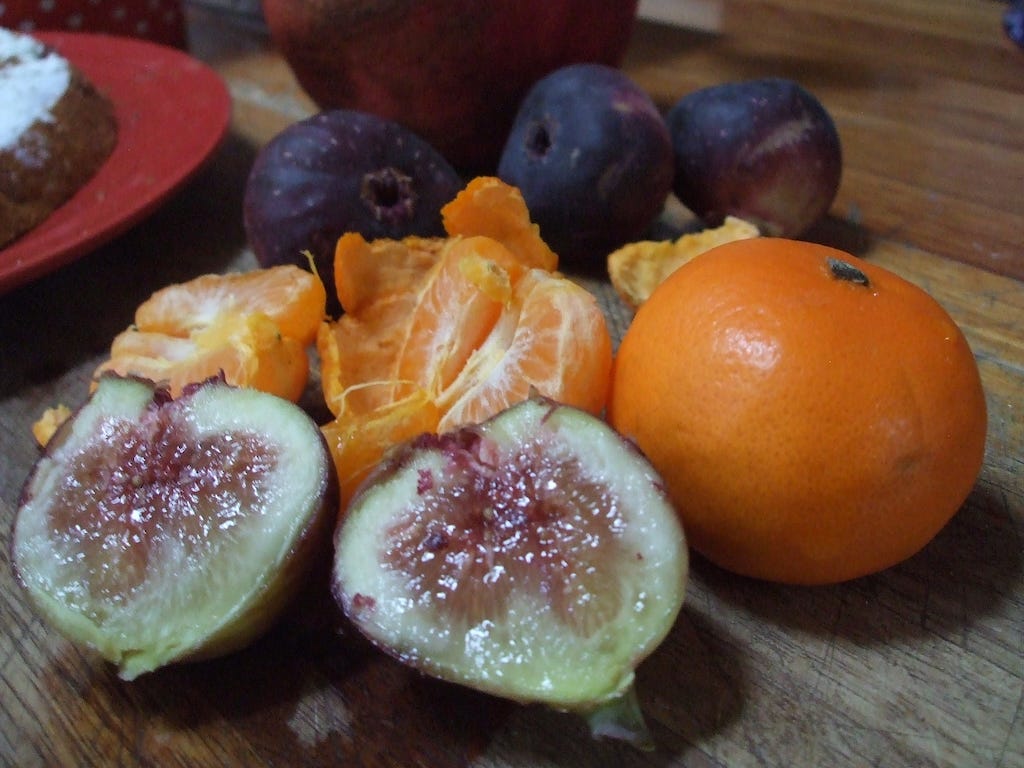
Were I a lyricist, I might break into song. Were I a bard, I’d pen a poem. Alas, alas, I am nothing but a piker who strings alphabet bits into words, and glides them onto the invisible thread that makes a sentence a sentence. And so, herewith, in words and only words, we gather today to sing the praises of the only fruit I know that fills my mouth with so much delectability I wish I needn’t swallow.
How’s that for introduction?!?
It’s figgy season in the produce aisle, when those zaftig fruits, their skin the color of a nasty bruise, their flesh as tender pink-near-red as you might find outside the pages of a naughty slick, arise from crates and all but cry: Pluck me! Pluck me!
And so I do. Morning after morning as summer lists toward autumn, as September arises, leaving hot August in the dust, I imbibe. One sweet orb at a time. The slower the better, surely.
Ficus carica (carica, the name Carl Linnaeus plucked when naming names, is derived from Caria, the ancient region in Asia Minor—now somewhere in Turkey—where the sumptuous fruit prized by Romans blossomed on the bough), aka the fig you find today nestled among the apple and banana bins, is among the select handful of nourishments about which I might fantasize greedily and all year long.
Let us begin our encomium with this delicious wonderment: Did you know the fig is not a single simple fruit; it is a syconium—a unique botanical structure consisting of “a fleshy, hollow stem or receptacle with hundreds of tiny unisexual flowers blooming inside the cavity rather than facing outward.” Yes, hundreds, maybe even a thousand, teeny sand-like seeds (the most melt-in-your-mouth seeds you ever seized) comprise the fleshy fruit. And imagine how they’ll taste now that you know each one is a unisexual flower?!?!
If botany’s not your thing, and that morsel alone does not float your figgy boat, how ‘bout this, from more literary corners: At rapid clip, we might flip through the pages of literary history and find the fig cannot be kept away. In no historical order, a sweep through literature finds the fig popping up in the imaginations—and on the pages—of Shakespeare, Sylvia Plath, D.H. Lawrence, Marcus Aurelius, Pliny the Elder, and the scribes of Holy Scripture, from the Hebrew Bible clear through the Book of Revelation.
If we turn back far enough, we find the fig the prescribed start-of-school-year fruit, as Plato & Co. gobbled them voraciously and dubbed them “the food of philosophers.” (Though they would have said so in ancient Latin, a language I do not know.) Apparently, those early thinkers favored figs for fueling deep philosophical discourse, and filled their plates and bellies thusly. If only I had known when I packed my own boys’ brown-bag lunches.
Leaping centuries forward, I find myself titillated by David Herbert Lawrence, ol’ D.H. himself, who in his famous poem “Figs” (from the collection Birds, Beasts and Flowers, published in 1923) tickles our appetites when he opines that “every fruit has its secrets,” and pronounces the fig, in particular, “a very secretive fruit,” adding “you feel at once it is symbolic.” He likens its “rosy, moist, honeyed” flesh to a “ripe womb,” with its “flowering all inward.”
It’s been written that not only was D.H. flirting with the sexual, but too he was drifting into the theological. Scholars of both literary and theological ilk argue that he wants us to read a spiritual imperative into the ripening of the fig’s hidden fruit. That is, as with the fig, so too the human soul must do its deepening in the inner sanctum, the womb ever within. Its secrets, Lawrence insists, are to be kept entirely hidden—until it’s broken open. Sacredness, he argues, must be shielded from the intellectual, analytical, modern world. The divine inwardness, that which we so arduously seek, is the fig’s sacred wisdom, ripe and bursting to impart. Is that not a hefty volume to read into a fruit less voluminous than your curled-up fist?
Perhaps the most famous modern literary star turn for the fig is that found in the pages of Sylvia Plath’s autobiographical novel, The Bell Jar, where she uses the fig tree analogy as a metaphor for paralysis of choice.
“I saw myself sitting in the crotch of this fig tree, starving to death, just because I couldn’t make up my mind which of the figs I would choose…”
Alas, Plath’s protagonist, Esther, sits starving beneath the tree, as above her each green fig (each one representing a life role: poet, writer, editor, traveler, wife) first ripens, then blackens, wrinkles, and soon rots. It’s the truth that paralyzing indecision is a decision—as risky as making the wrong choice. Or, as one writer (who goes by the internet moniker hansnoopy) has argued: “i don’t think it’s just about choice. i think it’s about doubt. that quiet, paralyzing kind that sinks into your bones. the kind that makes everything feel too big, too fragile, too final.” hansnoopy goes on to write: “that is the ache underneath the fig tree. it’s not about which life you want more. it’s the grief of knowing you can’t live them all. the cruel way time slips past while you’re stuck between possibilities.” Might that not be worth a ponder, plopped beneath the nearest arbor—fig or otherwise?
And lest we omit the genesis of it all, we cannot overlook what’s written to have happened in the beginning, when we find the plump orb cast in the role of Original Sin.
You know the story: Adam and Eve are lolling about in the paradisical Garden of Eden, when ol’ Eve bites into a sweetness (aka the Forbidden Fruit) that brings about the Fall. Long held to be an apple, a whole new school of fruit play has arisen over the years, and a good number of Hebrew and ancient Christian scholars have more or less reverse-engineered the deal to deduce that it was a FIG that befell the Fall.
Here’s how their thinking goes, pinning it all on one key line: when Adam and Eve had eaten the fruit, and their eyes were opened, “and they knew that they were naked . . . . they sewed fig leaves together, and made themselves aprons,” the thinkers posit that if the leaves of fig were within easy reach of the sewing basket, well then mightn’t that have been the very fruit into which Eve sank her sorry lips? And never mind the apple, maligned for all these years.
That debate we’ll leave to the historians and forensic theologians, while I for one partake of more than my fine figgy fill.
Before I go, though, one last bit: Leave it to the Italians to dictate terms for fig consumption. They tell us there are two ways to down a fig—one vulgar, the other “proper.” Put your lips to its skin, bite out the flesh, and gulp it down in one swift swallow. That, they say, is vulgar. Or, slice it quarterly into crescent moons, and imbibe with tines of fork. That, the prissy ones insist, is the only proper route. I myself am ambifigorous; I eat my fig all ways.
Whilst you stuff your mouth (among the options: Black Mission, Brown Turkey, or the green Calimyrna) any which way you choose, I invite you to partake of figgy poetry. Beginning here, with the great Naomi Shihab Nye, whose father, a refugee, hailed from the holy land of Palestine, and whose everlasting quest was to find again a fig tree.
MY FATHER AND THE FIG TREE
For other fruits, my father was indifferent.
He’d point at the cherry trees and say,
“See those? I wish they were figs.”
In the evening he sat by my beds
weaving folktales like vivid little scarves.
They always involved a figtree.
Even when it didn’t fit, he’d stick it in.
Once Joha was walking down the road
and he saw a fig tree.
Or, he tied his camel to a fig tree and went to sleep.
Or, later when they caught and arrested him,
his pockets were full of figs.
At age six I ate a dried fig and shrugged.
“That’s not what I’m talking about! he said,
“I’m talking about a fig straight from the earth –
gift of Allah! — on a branch so heavy
it touches the ground.
I’m talking about picking the largest, fattest,
sweetest fig
in the world and putting it in my mouth.”
(Here he’d stop and close his eyes.)
Years passed, we lived in many houses,
none had figtrees.
We had lima beans, zucchini, parsley, beets.
“Plant one!” my mother said.
but my father never did.
He tended garden half-heartedly, forgot to water,
let the okra get too big.
“What a dreamer he is. Look how many
things he starts and doesn’t finish.”
The last time he moved, I got a phone call,
My father, in Arabic, chanting a song
I’d never heard. “What’s that?”
He took me out back to the new yard.
There, in the middle of Dallas, Texas,
a tree with the largest, fattest,
sweetest fig in the world.
“It’s a figtree song!” he said,
plucking his fruits like ripe tokens,
emblems, assurance
of a world that was always his own.
This poem is from 19 Varieties of Gazelle, by Naomi Shihab Nye.
Why you might ask have I dallied here on such a singular subject as the sublime fig? Well, if a weekly writerly habit is meant to keep one’s muscles well-oiled, and one’s synapses firing ably, then practice practice practice is the mantra and the key. And, over the many years, I’ve always found most delicious those deep delvings into the arcane: an essay on the semi-colon, among the most memorable (julia keller, chicago tribune); an ode to socks (pablo neruda); the death of a pig (e.b. white). And so, biting into a fig the other morn, I mused to myself: this thing deserves an ode. Or at least a consideration of some length. And now you have it: the figgy ode.
If you were to pluck but a single morsel of this season, with intent to sing its praises, what might be the particular of your choice? In other words, of all the simple threads that weave a day, which single one might you pull, to hold it up to the holy light and extol its extraordinary ordinary wonders?
And let us close, finally, with the words of the now late, ever great, poet farmer Wendell Berry, who died this past Monday . . .
All that I serve will die, all my delights,
the flesh kindled from my flesh, garden and field,
the silent lilies standing in the woods,
the woods, the hill, the whole earth, all
will burn in man’s evil, or dwindle
in its own age. Let the world bring on me
the sleep of darkness without stars, so I may know
my little light taken from me into the seed
of the beginning and the end, so I may bow
to mystery, and take my stand on the earth
like a tree in a field, passing without haste
or regret toward what will be, my life
a patient willing descent into the grass.
—Wendell Berry (1934 - 2026)
On the high desert plateau of Arizona, just north of the Mogollon Rim, where the barren Valley of the Sun changes to the Colorado Plateau, a visionary architect stood, circa 1955, and foresaw his City of the Future.
He worked with earth-casting techniques to build, using the local soil, sand, and silt to make concrete. His vision was a dense urban core surrounded by open land, rather than sprawl. His vision took root, the city grew.
Of Italian origin, he planted fig trees in his city. His link to his childhood.
I stood there circa 1994, biting into a fresh plucked fig. Divine ecstasy as the canyon surrounded me.
A fig in Eden? Not hard to believe.
Oh. Babs, once again your invitation to pause and consider the fig, or the moment, or our breath or in my case the twirl of the cottonwood golden leaf as it leaves the branch that grew it so perfectly. Leaving like a child, spinning, landing. The great mother tree simply standing and accepting the seasons of life. And Naomi Shihab Nye and Wendell Berry. Two of my many inspirations for noticing. As are you! XOXO Jan janetsterkhealingjourneys.com