

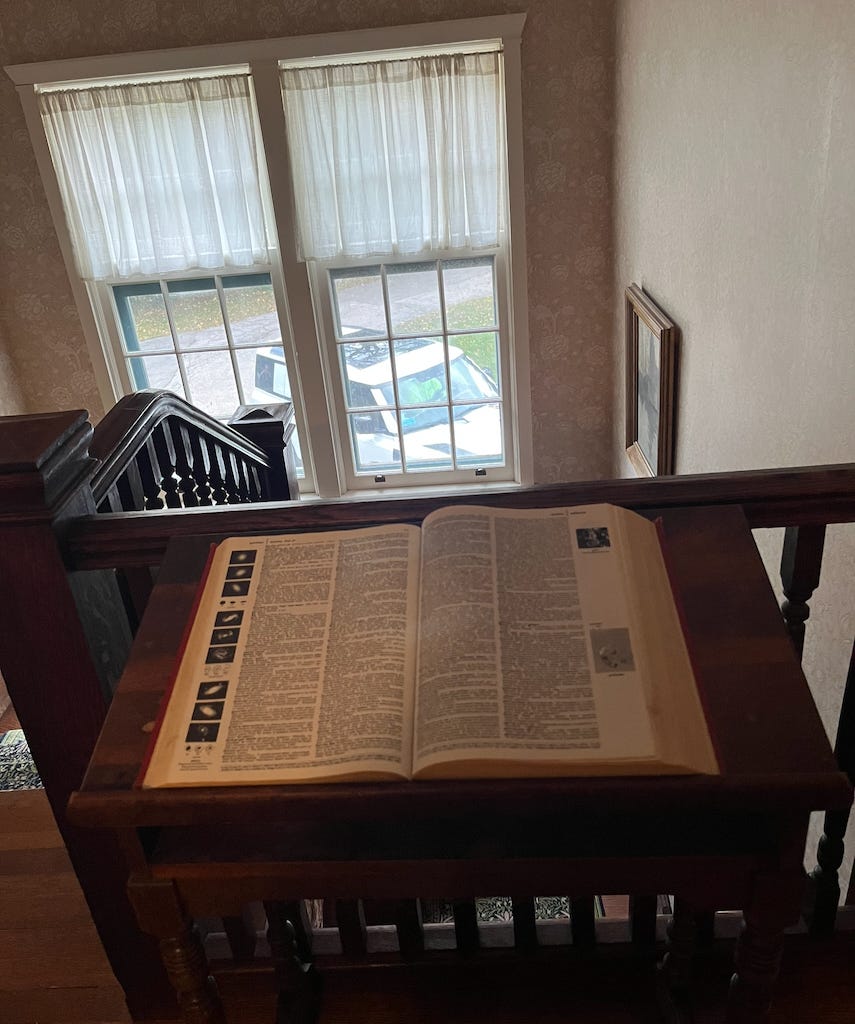
At the top of the stair at the house that Howard Van Doren Shaw built, footsteps away from the bedroom doors that hang with needlepoint tags spelling out “Alice’s Rooms,” or “Top of the Stairs Room” or “Albert’s Room,” there abides a dictionary. Its pages spread wide, the wings of a grand and wise bird perhaps, it has lain poised for more than a century, awaiting the curious or the one who awakes from a dream and simply must know the meaning or spelling of whatever is the word of the middle-night hour.
A dictionary on duty not far from sleeping chambers is not the usual place to post such a tome, but how apt it is in a house where poetry and craft seemed to seep through the walls, to whistle from the radiators, and spill in through the screens on the sleeping porches.
It was the perfect appointment for one (c’est moi!) who just the other week ordered up a first edition 1942 Webster’s Dictionary of Synonyms, and has been turning its pages, poring alphabetically up and down the columns of bold font and italics and the curious abbreviations one finds in a compendium of the world’s finest English-speaking lexicographers.
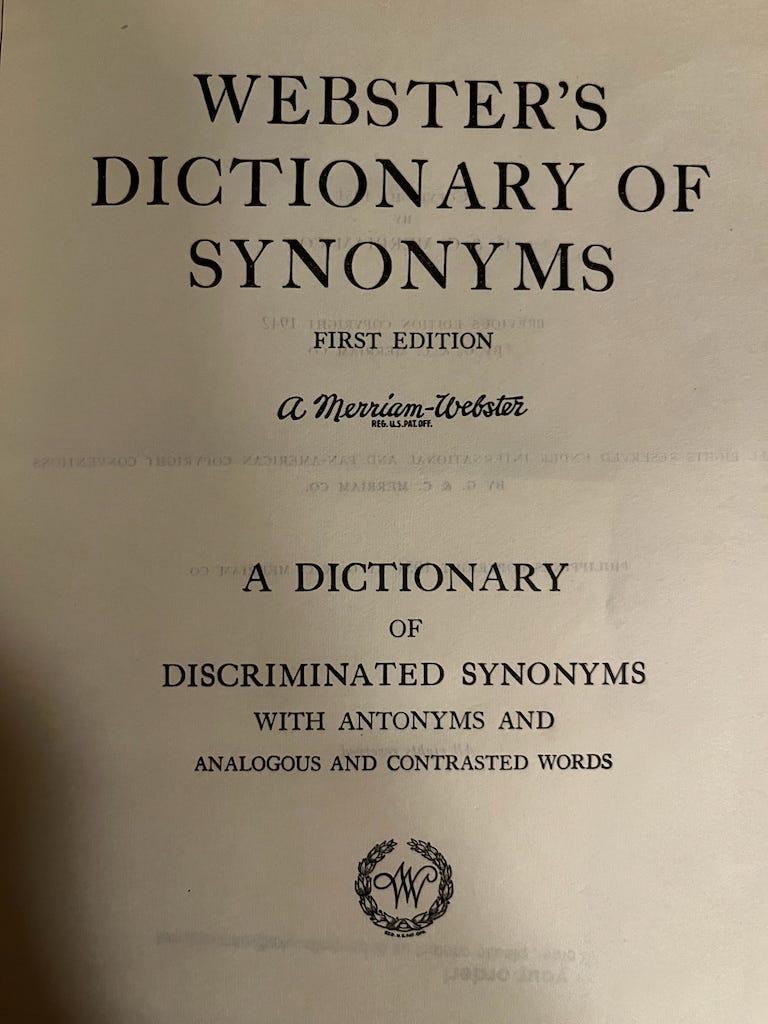
I was pointed toward that particular octogenarian edition by one of the most erudite classicists I know, a grammarian and gentleman of the highest order who praised it as “one fine work to consult on these matters of linguistic discrimination,” and lauded its capacity “to discern subtle shades of meaning and make our writing precise.” (Guess how many minutes between the time I scanned that sentence and commenced my search for a musty old copy? If you guessed zero I will send you a scanned page from the alphabet letter of your choosing.)
Right there in the first sentence, I grasped the volume’s raison d’être: “The publishers of this book have long felt that there is widespread need for a work devoted to synonymy that emphasizes discrimination among synonyms and that provides accessory material in the form of word lists of various kinds.”
I’ll have me a discriminating synonym any day!
In the pages immediately shadowing that bold claim, the dictionary goes on to lament the inexplicable void in linguistic history that, until this volume appeared in 1942, had left the world without a tome where one might pick and choose a plumb poecilonym (that is, a word whose meaning is much like another, but for reasons of the author’s idiosyncratic choosing, beats all the others).
Indeed, the so-called “1942” suffers no fools, slash-and-burning nearly all who came before. Case in point: In pooh-poohing one attempt at synonymy, one penned by a British woman by the name of Hester Lynch Piozzi, the editors of the 1942 Webster’s downright grind it with their boot heels, writing: “It is in fact never profound: it is full of errors or dubious assertions, and it is often absurdly naive.”
Well, then!
(Dear Mrs. Piozzi’s defense, the editors let on, was her modest claim that her book “is intended chiefly for a parlour window” and is “unworthy of a place upon a library shelf.” Oh, dear, such feigned and forced humility; the art of self-deprecation is not so often pretty.)
It was the crusading cause of the discriminating editors of “A Dictionary of Discriminated Synonyms with Antonyms and Analogous and Contrasted Words” to, first, lay out their “protest as to the loosening of the definition” of synonym and, secondly, to provide the new world of the mid-twentieth century with a book that finally gets the job done.
In other words, while it might seem to be synonyms for snobs, a kinder, gentler way to put it might be to claim these pages are for the properly persnickety, those who refuse to trade in roughshod language, slopping words onto the page to see, like half-cooked spaghetti strands flung against the wall, which might stick. Oh, no, not us!
Those who turn to this tome will want to know, for instance, that whereas abnormal frequently connotes strangeness, its synonym atypical stresses divergence, upward or downward, from that which has been established as average, and aberrant seldom loses its literal implication of wandering or straying.
But I am getting far too tangled in the weeds here, as I romp and play in the yellowed pages that landed on my doorstep with a thud.
What this is all about is the rejuvenation that comes when one finds oneself entangled with those who treasure words, those who hold one slab of alphabet letters to the light to behold from every angle. Those who might spend precious, priceless, invaluable time consulting the synonymic gods with exacting—nay, scrupulous, punctilious, squaring—attention and precision.
If words are the instruments of utterance (and they’ve been so—have they not?—ever since the paradisiac moment in the Garden of Eden when Adonai bellowed from the heavens, tsk-tsking Eve and Adam, sternly warning them not to bite the shiny apple (or fig or pomegranate or citron, whichever tempting fruit you please), then we’d best pluck the very one that captures the fullest, nearest essence to whatever it is we mean.
We live now in a world where words get ugly. Where words divide and demean and demonize. Too little care is afforded their employ. My heart breaks daily—nay, quarter-hourly—as I read the screeds, the insults, the cruelties pouring forth from podiums and helicopter pads, all meant to humiliate, debase, degrade, scoff, jeer, sneer, mock, deride, and ridicule. “To shatter the human spirit” is the one phrase the 1942 forgot to add in discriminating what it means to insult. With harsh intent, no less.
Take back language, is what I say. Take it back with gentle, loving, fierce and robust care. Remember, too, that words can stitch a broken shattered heart, convey an utterance that will never be forgotten (how many lines in your life have been spoken to you that, to this day, you can recite verbatim?).
While the gesture, the eye roll, and the squeeze of a hand all do mightily to get the point across, I’ll never leave home without my vault—my reservoir, my cistern, my receptacle—of crisply discriminated words. I’m with Ms. E. B. Browning, the English Romantic poet of the Victorian era, who set out to count the many, many ways to say I love you so.
If I might use a word to wound or weave whole a broken heart, why oh why would I not wisely choose the latter?
Are there lines from your long-ago that, to this day, you can recite verbatim, so profoundly were pressed against your heart?
* In one of the wonders of this life I live twined to Mr. B.D. Kamin, we were invited the other night to spend a magical interlude in Howard Van Doren shaw’s famed Ragdale house, an exemplar of American Arts and Crafts that oozed its charms on me. Built in 1897 in the leafy burg of Lake Forest, Illinois, as the “country home” of the architect and his progeny, it’s now the centerstage of an artists’ residency, and it was nothing short of miraculous to be nearly alone in that old house, to nosh on leftovers at the kitchen table (as if any old Saturday night might find us in such an esteemed backroom), to curl into its hearth-side inglenook well before the night dissolved to dawn.
As promised last week, that little essay I wrote about the haunting parallels between Il Papa’s lung surgery and mine did find its way into the light, to America Magazine, the Jesuit review of culture and faith, where yesterday it was floating at the top of their site….And here tis (I can only post the link here, but they give you three freebies before the paywall clanks down…)
And finally, my lovely lovely publisher, Brazos Press, asked me to please start tucking here a little reminder about Broken Open: How Our Most Fragile Seasons Invite Us to Extravagant Love, my chronicling of the spiritual epiphany that came to me in the wake of that lung cancer diagnosis. I think they’d love it if you pre-order, which you can do here and get a 40-percent discount, baby!!! (p.s. I didn’t know about the discount till yesterday, but for 13 bucks you get a book!!!)

how bout a little peek at that Howard Van Doren Shaw house the world knows as Ragdale?


My word, quite a week you had. From "rags to riches," one might say.
Concerning 1942, while those lexicographers in Springfield, Mass were busy discerning distinctions, Dwight Eisenhower had a meteoric rise, from little known field officer, to head of the War Plans Division, to Chief of the newly created Operations Division, to Commander-in-Chief of Allied Forces. All within one year, a swift, sudden, even dazzling series of promotions.
An erudite five-star general in an era when hard working editors would discern subtle shades of meaning, such speaks - I might suggest - to how the war was won, fascism defeated. Alas, we have fallen from grace, words now as cudgels.
Stay the course, oh bard of Friday mornings!
There are no coincidences. In our home, as sentry, stands an unabridged 1947 Second Edition Webster's New International Dictionary of the English Language, semper paratus - like a Marine - ever at attention to anyone curious enough to peruse.
Of note, in 1947 Eisenhower reorganized the U.S. military, replacing the War Department with the National Military Establishment (later the Department of Defense) and creating the Department of the Air Force and the Central Intelligence Agency (CIA).
We have come full circle, it would seem. I trust the lexicographers shall outfox the Fox News War mongers.
In the meantime, this news: "Hegseth was so eager to get [one of the two floor globes General Dwight D. Eisenhower used during World War II] in place that rather than waiting for trained curators to move it, as is expected for any such priceless historic artifact, Hegseth’s staff decided to retrieve it on their own. They dropped it. The artifact smashed into its base, and the stand impaled it, ripping a gash through the fragile globe. It never did end up in Hegseth’s office."
What, then, is the discriminating synonym for "pompous pomaded asshole"?
Ragdale! How lucky for you two! How vintage-y cozy!
When I took a tour, saw framed letters by Carl Sandburg (exciting to see his actual signature!) and a closet there whimsically painted by cartoonist Lynda Barry - Substack doesn’t allow posting photos in these comments. ☹️
Also ✅ new book ordered.